Lecos
Glass Eyeshadow Jars may look simple on a beauty shelf, but choosing a dependable supplier takes more than comparing prices. A jar’s weight, rim finish, closure fit, and interior cleanliness all affect how it feels and performs. A thick glass base can add a premium touch. A poorly matched lid can make that same jar frustrating to use.
This guide compares ten Chinese manufacturers through practical sourcing criteria: product range, customization options, sample quality, production consistency, and communication. Packaging consultant Lin Wei offers this useful reminder: “A good jar should look refined, close securely, and arrive consistent from batch to batch.” Treat that as a buyer’s test, not a substitute for inspecting samples. Specifications and capabilities can change, so confirm details directly with each manufacturer.
Small differences matter. Check whether the lid sits level, whether the glass has visible bubbles, and whether decoration aligns across several samples. Ask about minimum order quantities, lead times, packaging protection, and quality checks. Requesting a sample is wise. It is not foolproof. A single sample cannot show how an entire production run will look.
The list is a starting point for comparison, not a guarantee of fit. Some suppliers may suit custom launches; others may be better for established designs or larger orders. Use the profiles to narrow your search, then verify the details that matter to your product, budget, and schedule.
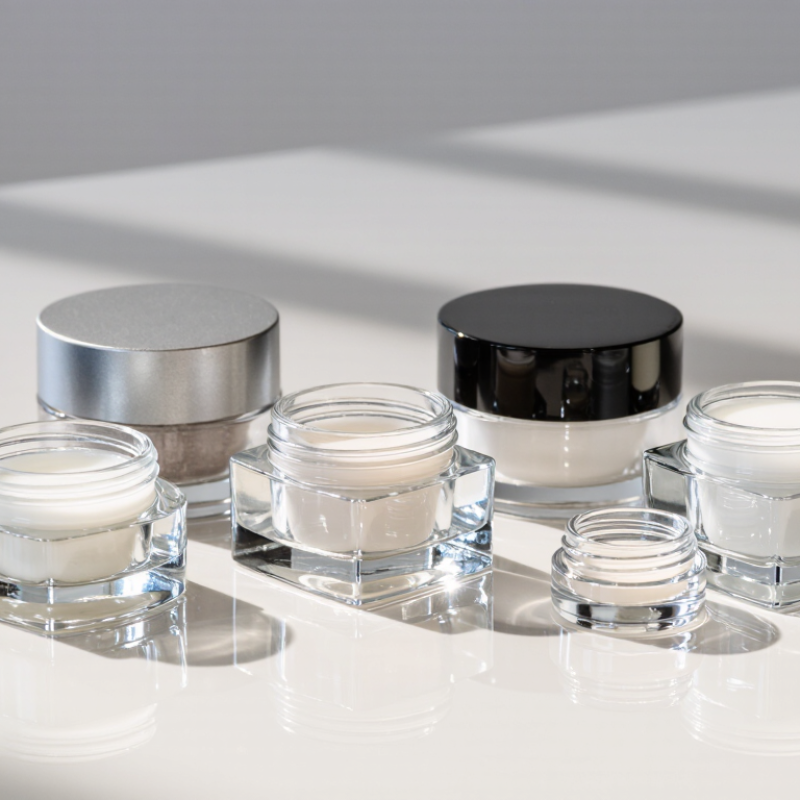
Glass eyeshadow jars are small containers designed mainly for loose powders, shimmer pigments, and creamy formulas. Their transparent walls make the shade easy to identify, even in a crowded makeup drawer. A screw cap helps limit spills, while an inner liner can improve the seal. The jar itself does not guarantee freshness or leak resistance; closure fit matters.
Loose shadow benefits from a wide opening and enough room for a brush or fingertip. Some jars include a sifter, which controls how much powder comes out. That detail can reduce mess, though tiny holes may clog with damp or oily product. Pressed eyeshadow is usually better suited to a flat pan than a deep jar. Small distinction. It matters.
Glass feels solid and keeps its shape, but it is heavier and can break if dropped on a tiled counter. Frosted or colored glass may conceal residue, while clear glass shows the product level and any buildup around the rim. For cream shadow, check that the lid closes evenly and that the formula works with the liner material. A jar can look elegant yet feel awkward to use. Clean, dry tools and a well-fitting cap help keep the contents in better condition.
These capacity points provide a simple reference when comparing small glass jars for loose or pressed eyeshadow. They are illustrative sizes, not a claim about industry standards or market share. Fluid-ounce equivalents use the US conversion 1 mL ≈ 0.033814 US fl oz.
When comparing Chinese glass eyeshadow jar manufacturers, begin with the jar itself, not the catalog photo. Request samples in the intended size and inspect them under bright light. Look for bubbles, uneven rims, cloudy patches, and sharp edges. Small details matter. Ask for the glass type, capacity tolerance, and documented inspection steps. A neat sample is useful, but it cannot show how every production batch will perform.
Check how the jar works with its cap, insert, and filling process. A lid that feels secure on one sample may fit differently across a large order. Ask the manufacturer to test assembled pieces and share the method and results. Also check whether decoration survives rubbing and routine handling. Evidence beats promises. If your team has a filling line, send its key dimensions early; otherwise, even a well-made jar may cause avoidable delays.
Production reliability deserves equal attention. Request clear information about minimum order quantities, sample timing, production capacity, and defect handling. Review quality records or audit documents where available, and confirm who approves changes to drawings or materials. Communication is part of quality. Note how quickly questions receive specific answers. I would still leave room for doubt: factory documents do not replace checking pre-production samples and agreed inspection criteria.
China’s glass packaging sector includes manufacturers that produce eyeshadow jars in different shapes, capacities, and finishes. A useful top-ten comparison should examine more than price. Check glass clarity, wall thickness, rim smoothness, and lid fit. These details affect shelf appearance and everyday use. A thick base can feel more stable, while a clean rim helps the lid sit evenly. Small differences matter.
Tips: Request samples before discussing a large order. Test the jar with the intended formula and applicator. Ask for written details on capacity, decoration, packaging, lead time, and minimum order quantity. Confirm whether quoted prices include printing or surface finishing. Keep the questions specific.
The strongest supplier for one project may not suit another. Some factories focus on custom colors or frosting; others may offer more standard molds and simpler ordering. Ask how the maker checks dimensions and inspects finished pieces. Review sample consistency, not just one attractive unit. If possible, compare several jars side by side under natural light. This process takes time. It can still miss production variations, so confirm inspection steps and acceptable tolerances before approving the order. A clear specification sheet makes comparison fairer and reduces avoidable surprises.
When comparing China’s glass eyeshadow jar manufacturers, look beyond catalog photos. Check whether each supplier offers clear, frosted, colored, and thick-base jars, plus compatible lids and liners. Ask for drawings showing mouth diameter, capacity, wall thickness, and allowable weight variation. Details matter. A broad range is useful only when production samples match the approved specification.
Customization should include mold development, surface finishing, logo application, and color matching. Request a sample with the actual decoration, not just a plain jar. For production capability, ask about furnace capacity, annealing, inspection frequency, minimum order quantities, and repeat-order lead times. Eurostat reported that 75.9% of glass packaging waste was recycled in the EU in 2022. This is a regional benchmark, not proof of any factory’s performance, but it makes recycled-content claims and jar recyclability worth discussing. The weak point in many comparisons is that “custom” can mean only a new color. It may not include a new mold or tighter dimensional control. A factory audit or documented inspection record can help clarify the difference.
| Supplier Slot | Glass Jar Range | Customization to Confirm | Production Capabilities to Confirm | Evidence to Request |
|---|---|---|---|---|
| Supplier 1 | Not independently verified; request current eyeshadow-jar catalog and available capacities. | Confirm color, shape, decoration, lid, and insert options. | Confirm mold ownership, sample lead time, and order capacity. | Dated catalog, technical drawings, and production-site details. |
| Supplier 2 | Not independently verified; request current eyeshadow-jar catalog and available capacities. | Confirm color, shape, decoration, lid, and insert options. | Confirm mold ownership, sample lead time, and order capacity. | Dated catalog, technical drawings, and production-site details. |
| Supplier 3 | Not independently verified; request current eyeshadow-jar catalog and available capacities. | Confirm color, shape, decoration, lid, and insert options. | Confirm mold ownership, sample lead time, and order capacity. | Dated catalog, technical drawings, and production-site details. |
| Supplier 4 | Not independently verified; request current eyeshadow-jar catalog and available capacities. | Confirm color, shape, decoration, lid, and insert options. | Confirm mold ownership, sample lead time, and order capacity. | Dated catalog, technical drawings, and production-site details. |
| Supplier 5 | Not independently verified; request current eyeshadow-jar catalog and available capacities. | Confirm color, shape, decoration, lid, and insert options. | Confirm mold ownership, sample lead time, and order capacity. | Dated catalog, technical drawings, and production-site details. |
| Supplier 6 | Not independently verified; request current eyeshadow-jar catalog and available capacities. | Confirm color, shape, decoration, lid, and insert options. | Confirm mold ownership, sample lead time, and order capacity. | Dated catalog, technical drawings, and production-site details. |
| Supplier 7 | Not independently verified; request current eyeshadow-jar catalog and available capacities. | Confirm color, shape, decoration, lid, and insert options. | Confirm mold ownership, sample lead time, and order capacity. | Dated catalog, technical drawings, and production-site details. |
| Supplier 8 | Not independently verified; request current eyeshadow-jar catalog and available capacities. | Confirm color, shape, decoration, lid, and insert options. | Confirm mold ownership, sample lead time, and order capacity. | Dated catalog, technical drawings, and production-site details. |
| Supplier 9 | Not independently verified; request current eyeshadow-jar catalog and available capacities. | Confirm color, shape, decoration, lid, and insert options. | Confirm mold ownership, sample lead time, and order capacity. | Dated catalog, technical drawings, and production-site details. |
| Supplier 10 | Not independently verified; request current eyeshadow-jar catalog and available capacities. | Confirm color, shape, decoration, lid, and insert options. | Confirm mold ownership, sample lead time, and order capacity. | Dated catalog, technical drawings, and production-site details. |
Note: This is an unranked comparison framework, not a verified list of manufacturers. Supplier-specific product ranges, customization options, and production figures should be confirmed directly before publication or purchasing.
Choosing a glass eyeshadow jar manufacturer in China starts with the product, not the catalogue. Define capacity, glass color, wall thickness, opening size, and decoration needs. A jar that looks elegant may still feel heavy or awkward in a customer’s hand. Ask for dimensioned drawings and physical samples before discussing large orders. Details matter.
Test the jar with your actual formula, applicator, and closure. Check for leaks, chips, uneven rims, and coating wear after repeated handling. Ask how the factory inspects glass and handles rejected pieces. Request clear information about sample charges, minimum order quantities, production time, and packaging for shipment. A polished sample can mislead.
Communication is part of quality control. Share written specifications, approve a pre-production sample, and confirm how changes are recorded. If possible, arrange an independent factory assessment or review recent inspection records. Compare quotations by total cost, including protective inserts and freight preparation, rather than unit price alone. Some checks may feel excessive. They are cheaper than discovering a poor fit after thousands of jars arrive.
They are mainly used for loose powders, shimmer pigments, and cream formulas.
Its transparent walls make the shade and product level easy to see. Residue around the rim is visible, too.
Not by itself. A well-fitting cap and inner liner can help limit spills, but closure fit matters most.
Yes. It controls how much powder comes out and can reduce mess. Tiny holes may clog.
Usually not. Pressed shadow generally fits better in a flat pan.
Check glass clarity, wall thickness, rim smoothness, capacity, and lid fit. Ask for written specifications.
Test each sample with your formula and applicator. Compare several jars side by side under natural light.
Production pieces may differ slightly. Confirm inspection steps and acceptable tolerances; one attractive sample is not enough. I might be overlooking a detail.
This guide explores how Glass Eyeshadow Jars are used to store and present pressed powders, loose pigments, and other eye makeup products. It explains the features that matter when selecting a jar, including material quality, capacity, shape, closure performance, and suitability for product filling and everyday use. It also outlines key criteria for evaluating Chinese manufacturers, such as production experience, quality control, customization options, communication, and order flexibility.
The article reviews ten manufacturers and compares their product ranges, design support, decoration options, and production capabilities. Rather than relying on a single factor, businesses can use these comparisons to assess whether a supplier matches their packaging requirements, target market, budget, and expected order volume. The final section offers practical guidance for choosing a suitable manufacturing partner and building a clear, reliable sourcing process.
