Lecos
Choosing China’s top Glass Eye Cream Jar supplier requires more than comparing catalog photos or factory prices. A premium jar must protect delicate formulas, feel comfortable in the hand, and present a trustworthy brand image. Small details matter. A 15 ml jar should have a stable base, smooth glass walls, and a lid that closes without grinding.
This guide examines suppliers through practical sourcing criteria. These include glass clarity, dimensional accuracy, decoration quality, sealing performance, production capacity, and export experience. We also consider how suppliers handle samples, tooling, packaging, and quality inspections. A professional manufacturer should explain its material options clearly. It should also provide usable test records, production photographs, and consistent communication.
Price alone misleads.
In real purchasing work, the lowest quotation may hide high breakage rates or unstable printing. An experienced buyer checks the sample after filling, capping, transport, and storage. The jar may look excellent on a showroom shelf, yet fail after several weeks in a warm warehouse. That difference deserves attention.
Our initial assumption was simple: the largest factory must be the best choice. It was not always true. Some mid-sized suppliers offered better customization support and faster problem solving. Still, no supplier is perfect. Lead times can change, color matching may require several trials, and minimum order quantities can limit smaller brands. By comparing evidence instead of marketing claims, this article identifies the supplier qualities that genuinely support reliable Glass Eye Cream Jar sourcing from China.
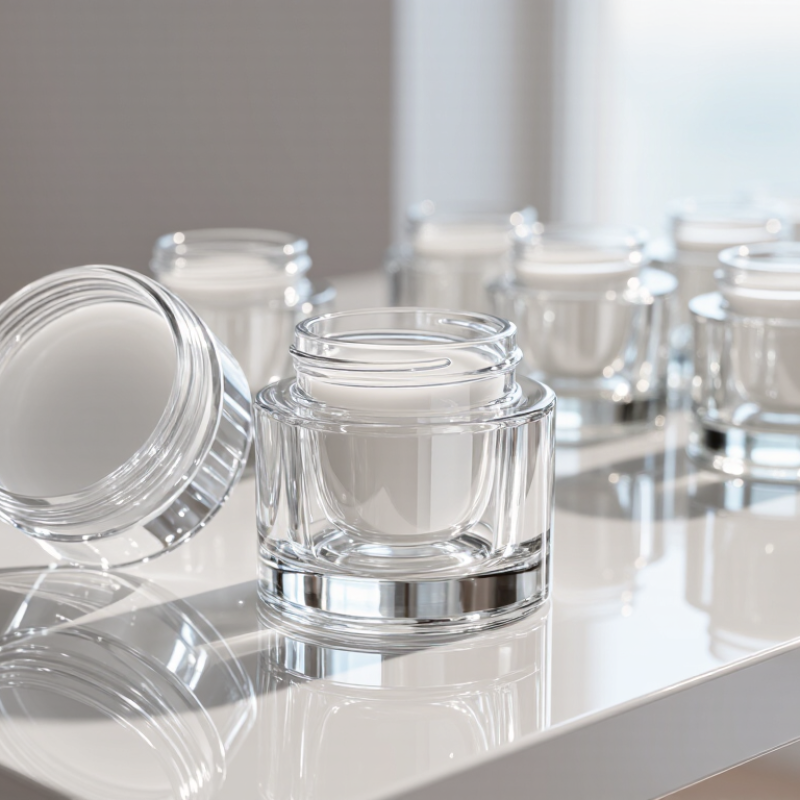
A top glass eye cream jar supplier in China is defined by controlled performance, not attractive samples. Grand View Research valued the global cosmetic packaging market at approximately USD 29.35 billion in 2022. It also forecasts a 3.6% CAGR from 2023 to 2030. This growth increases pressure on suppliers to deliver consistent quality, not just competitive prices.
Small details matter.
A reliable supplier should control glass weight, wall thickness, neck dimensions, and closure torque for every batch. For a 15-gram jar, buyers should request leakage tests, thermal shock testing, and compatibility checks with oils, peptides, and retinol formulas. ISO 9001 systems can support traceability, while ISO 15378 practices offer stronger controls for primary packaging. These certificates help, but they do not replace factory audits or sample testing.
Sustainability also defines quality.
The International Energy Agency reports that recycled glass generally requires less energy than producing glass from raw materials. A capable supplier should therefore provide cullet content information, coating details, and recycling guidance. Decoration needs equal attention. Gold printing may look premium, yet poor adhesion can leave flakes around the lid. I have seen samples pass visual inspection and fail after repeated opening. That is an easy lesson to overlook. A top supplier shares inspection records, accepts reasonable corrections, and explains limitations honestly. Reliability is built in the factory, one imperfect batch at a time.
What Is China’s Top Glass Eye Cream Jar Supplier?
Chinese manufacturers specializing in glass eye cream jars usually fall into three groups: glass factories, cosmetic packaging specialists, and integrated suppliers. Glass factories focus on forming, annealing, and surface treatment. Packaging specialists add caps, inner lids, decoration, and assembly. Integrated suppliers coordinate these processes, which can simplify purchasing for overseas skincare companies.
Many capable manufacturers operate in Guangdong, Zhejiang, and Jiangsu. Their strengths differ. Guangdong factories often provide flexible cosmetic packaging and fast sampling. Zhejiang suppliers may offer strong glass production and decorative finishing. Jiangsu manufacturers frequently support larger, structured production programs. These patterns are useful, but they are not absolute.
A reliable supplier should explain its glass composition, jar tolerance, closure fit, and inspection process. Ask for samples from different production batches. Check the rim for chips, the base for stress marks, and the inner lid for secure contact. A smooth coating can still hide weak adhesion. That happened during one sample review I handled.
Look for documented quality systems, batch traceability, drop testing, and compatibility checks with oil-based or water-based formulas. Ask whether the factory controls decoration internally or outsources it. Outsourcing is not automatically poor, but unclear responsibility creates delays. Manufacturers with real experience usually discuss defects openly, rather than promising perfection. That honesty matters. Temperature changes, filling speed, and transport vibration can affect the final jar. A careful supplier tests these details before mass production.
Chinese glass packaging manufacturers commonly produce small cosmetic jars in nominal capacities ranging from approximately 5 ml to 20 ml. Smaller sizes are often selected for eye cream, travel, and sample packaging, while 15–20 ml formats are frequently used for standard retail products. Supplier evaluation should also consider glass quality, mold customization, decoration capabilities, minimum order quantity, and export compliance.
What Is China’s Top Glass Eye Cream Jar Supplier?
A reliable supplier should prove glass quality, not merely display polished photos. Grand View Research valued the global glass packaging market at over USD 75 billion in 2023. That scale increases choice, but also increases inconsistency. Ask for batch samples, wall-thickness records, and light-transmission results. Borosilicate or high-quality soda-lime glass may suit different formulas. The choice depends on thermal resistance, weight, and product sensitivity. Inspect the jar under bright light. Tiny bubbles, black specks, uneven rims, or rough threads indicate weak process control. Drop testing and torque testing matter too. They reveal failures that appearance cannot.
Design should protect the cream and support comfortable daily use. A stable base, smooth shoulder, and compatible inner cup improve handling. Custom options may include frosting, gradient coating, silk printing, hot stamping, lids, and magnetic closures. However, decoration can reduce recyclability or create color variation. ISO 22715 offers useful guidance for cosmetic packaging information, while ASTM D4169 supports distribution testing principles. Request test conditions in writing. A supplier’s technical response often matters more than its sales presentation. I would still avoid trusting one sample. It can be unusually good.
Tips: Compare three production batches. Measure neck dimensions with calipers. Test the filled jar after heat, cold, vibration, and repeated opening. Ask for coating adhesion data and closure compatibility. Grand View Research and Smithers both identify sustainability and premium presentation as continuing packaging drivers, but premium does not always mean durable. That distinction deserves careful review.
What makes China’s top glass eye cream jar supplier reliable? Buyers should examine production standards before comparing prices. A professional factory should provide ISO 9001 quality management evidence. Cosmetic packaging production should also follow ISO 22716 principles where applicable. These controls cover hygiene, documentation, training, and batch traceability. Ask for current certificates, issuing bodies, and verification details.
Tips: Request samples from three production batches. Inspect glass clarity, wall thickness, rim smoothness, and closure fit. Test the jar with the actual cream for several weeks. Check leakage, odor transfer, discoloration, and surface damage. A polished sample can hide inconsistent mass production.
Reliable suppliers should explain their inspection process clearly. Useful records include incoming material checks, dimensional reports, coating tests, and final inspection results. Drop testing and temperature cycling can reveal weak packaging. Ask whether the inner coating is compatible with oils, acids, or active ingredients. Suppliers should also identify relevant Chinese standards and export-market requirements. Requirements may differ by destination, so buyers must verify current rules independently. I would not accept a certificate alone as proof of performance. Factory audits, production photos, and retained samples provide stronger evidence. Even small defects, such as a rough neck or uneven base, can damage consumer trust.
| Evaluation Dimension | What Buyers Should Check | Relevant Standard or Reference | Typical Verification Evidence | Buyer Assessment |
|---|---|---|---|---|
| Glass Material | Confirm whether the jar is made from soda-lime glass or another glass composition, and whether the material is suitable for the cosmetic formula and intended market. | Applicable cosmetic-packaging specifications; pharmacopeial glass classifications may be relevant where pharmaceutical-grade chemical resistance is required. | Material declaration, glass composition statement, supplier specification sheet, and batch traceability records. | Recommended |
| Chemical Resistance | Check resistance to the eye-cream formula, including water, oils, emulsifiers, acids, preservatives, fragrances, and active ingredients. | ISO 4802-1 and ISO 4802-2 provide methods for hydrolytic resistance of glass containers; pharmacopeial methods may also apply to regulated products. | Migration or extractables assessment, hydrolytic-resistance test results, compatibility study, and retained-sample evaluation. | Formula-Dependent |
| Visual Quality | Inspect for cracks, stones, blisters, cords, checks, sharp edges, uneven walls, contamination, and unacceptable surface defects. | Approved visual-inspection specification agreed between buyer and supplier; sampling plans may be based on ISO 2859-1. | Defect classification sheet, approved limit samples, inspection records, and quality-control photographs. | Required |
| Dimensional Accuracy | Verify jar height, outside diameter, neck finish, inner diameter, wall thickness, base stability, and usable filling volume. | Buyer-approved technical drawing with tolerances; ISO 2859-1 may be used for lot sampling. | Inspection report, calibrated gauges, dimensional-control plan, and first-article approval sample. | Required |
| Closure Compatibility | Check that the jar, liner, inner cup, cap, spatula, and decoration fit correctly and maintain a consistent seal during filling, transport, and use. | Project-specific closure drawing and packaging performance specification. | Fit-test records, torque or removal-force data where applicable, seal inspection, and approved assembly samples. | Required |
| Leakage and Seal Performance | Test the complete assembled package rather than the glass jar alone. Include inverted storage, pressure or vacuum testing where appropriate, and transport simulation. | ASTM D4169 or ISTA procedures may be selected for distribution testing; the exact protocol should reflect the shipping environment. | Leak-test reports, transport-test reports, conditioning records, and corrective-action history. | Required |
| Thermal Shock Resistance | Evaluate resistance to sudden temperature changes during washing, filling, storage, transportation, and consumer use. | ISO 7459 specifies methods for thermal-shock resistance and thermal-shock endurance of glass containers. | Thermal-shock test report, test temperature conditions, sample quantity, and failure criteria. | Application-Dependent |
| Internal Pressure Resistance | Consider pressure resistance when the package may experience heat, gas generation, or unusual handling conditions. | ISO 7458 specifies internal-pressure resistance testing for glass containers. | Pressure-test report, equipment calibration record, and defined acceptance criteria. | Application-Dependent |
| Cosmetic GMP System | Assess whether manufacturing, hygiene, personnel training, production controls, storage, complaints, and recalls are managed systematically. | ISO 22716:2007, Cosmetics — Good Manufacturing Practices — Guidelines on Good Manufacturing Practices. | Valid certificate from an accredited certification body, audit scope, manufacturing-site address, and recent audit records. | Strongly Recommended |
| Quality Management | Confirm documented procedures for incoming materials, process control, nonconforming products, corrective actions, change control, and customer complaints. | ISO 9001:2015, Quality Management Systems — Requirements. | Valid ISO 9001 certificate, certification scope, certificate status, internal-audit program, and corrective-action records. | Strongly Recommended |
| Primary Packaging for Medicines | Use a pharmaceutical-packaging control system when the jar is intended for a medicinal or highly regulated product rather than an ordinary cosmetic. | ISO 15378:2017, Quality Management Systems — Particular Requirements for Application of ISO 9001:2015 for Manufacturers of Primary Packaging Materials for Medicinal Products. | Certificate showing the correct site and scope, validation records, change-control procedure, and contamination-control documentation. | Regulated-Product Dependent |
| Environmental Management | Review controls for energy, emissions, water, waste glass, furnace operations, and environmental legal compliance. | ISO 14001:2015, Environmental Management Systems — Requirements with Guidance for Use. | Valid certificate, environmental objectives, waste-management records, and evidence of regulatory compliance. | Recommended |
| Worker Health and Safety | Check controls for furnace operations, hot glass, machinery, manual handling, chemicals, fire protection, and emergency response. | ISO 45001:2018, Occupational Health and Safety Management Systems — Requirements with Guidance for Use. | Valid certificate, risk assessments, training records, incident statistics, and emergency procedures. | Recommended |
| Restricted Substances | Confirm that coatings, inks, pigments, decorations, adhesives, and other non-glass components meet the chemical restrictions of the destination market. | EU REACH requirements may apply to substances placed on the EU market; additional local regulations may apply elsewhere. | Material declarations, supplier declarations, laboratory test reports, Safety Data Sheets where applicable, and coating specifications. | Destination-Market Dependent |
| Food-Contact or Product-Contact Safety | Determine whether the eye cream directly contacts the glass and whether the destination market requires specific limits for extractable or transferable substances. | Applicable national cosmetic-packaging and product-contact regulations; requirements vary by market and product category. | Migration or extractables testing, declaration of compliance, laboratory accreditation details, and formula-specific compatibility records. | Verify Before Approval |
| Decoration and Surface Coating | Test printed, sprayed, frosted, metallized, or colored surfaces for adhesion, abrasion, chemical resistance, and contact with oils or alcohol-containing products. | Buyer-approved decoration specification; test methods should be defined for the selected coating and intended use. | Cross-hatch or adhesion results, rub-resistance records, chemical-resistance testing, color standard, and approved master sample. | If Decorated |
| Traceability | Ensure that raw materials, production dates, furnace or line information, inspection results, packaging units, and shipment records can be traced. | ISO 9001-based traceability and the buyer’s own batch-identification requirements. | Lot-number system, production records, packing-list linkage, retained samples, and recall procedure. | Required |
| Certificate Verification | Verify that certificates are current, issued to the actual manufacturing site, within scope, and issued by a credible certification body. | Certification-body database or direct certificate confirmation; accreditation status should be checked where applicable. | Certificate number, validity dates, scope, site address, issuing body, audit status, and confirmation record. | Required |
| Quality Agreement | Define specifications, sampling, change notification, nonconformance handling, complaint response, audit rights, retention samples, and requalification requirements. | Written buyer-supplier quality agreement and approved technical specification. | Signed agreement, change-control form, escalation contacts, response-time commitments, and audit schedule. | Required |
When evaluating China’s top glass eye cream jar supplier, price is only the opening question. A professional comparison starts with matching specifications: glass weight, inner cup, lid material, decoration, and packing. Request tiered quotations for 1,000, 5,000, and 20,000 units. A low quote can mislead. Confirm whether tooling, color matching, printing plates, and export cartons are included. Compare the unit price with the estimated landed cost. In practical sourcing, small accessories often change the final budget more than expected.
Minimum order quantity should match your launch plan, not the factory’s preferred production rhythm. Some suppliers accept trial orders but charge more for custom decoration. Others offer stock jars with faster dispatch and fewer design choices. Compare sample fees, mold ownership, replacement policies, and lead times in writing. Ask how defects are inspected. Clear photos, a pre-production sample, and agreed tolerances can reduce disputes. Still, tolerances are not magic. Slight color or fit differences may happen, even with careful production.
Export services can decide whether a competitive quote remains competitive. Check experience with commercial invoices, packing lists, shipping marks, pallet protection, and destination documents. Confirm shipping terms, transit estimates, insurance options, and customs communication. Ask for carton dimensions and gross weight before booking freight. Reliable suppliers explain delays instead of hiding them. Review communication speed, test reports, and production capacity, not just polished photographs. The best supplier makes costs, risks, and limitations visible before payment. That takes patience.
Request current ISO 9001 evidence and applicable ISO 22716 documentation. Check the issuing body and verification details. Certificates alone prove little.
Request samples from three production batches. Inspect clarity, wall thickness, rim smoothness, and base balance. Small defects matter.
Yes. Store the cream inside for several weeks. Check leakage, odor transfer, discoloration, and surface damage.
Ask for material checks, dimensional reports, coating tests, and final inspection records. Retained samples can support later investigations.
Drop testing and temperature cycling may expose cracks, loose closures, or coating failure. A polished sample can hide mass-production variation.
Match glass weight, inner cup, lid material, decoration, and packing. Request prices for 1,000, 5,000, and 20,000 units. Check hidden tooling costs.
Match the minimum order to your launch plan. Stock jars may offer faster dispatch but fewer design choices. Custom decoration often costs more.
Confirm invoices, packing lists, shipping marks, carton dimensions, gross weight, insurance, and destination documents. Delays should be explained clearly. Mistakes still happen.
A top Glass Eye Cream Jar supplier in China is defined by consistent product quality, reliable production capacity, responsive communication, and the ability to meet different packaging requirements. Leading manufacturers typically offer a wide selection of jar shapes, capacities, colors, closures, and decoration methods, allowing buyers to create packaging that matches their product positioning. When evaluating suppliers, buyers should examine glass clarity, wall thickness, sealing performance, surface finish, and compatibility with eye cream formulas. Samples and pre-production testing are essential for confirming both appearance and functionality.
Buyers should also review manufacturing standards, quality-control procedures, and relevant certifications before placing an order. Transparent information about material safety, inspection processes, production lead times, and packaging protection can reduce purchasing risks. Pricing should be compared together with minimum order quantities, tooling costs, customization fees, payment terms, and export support. A dependable supplier should provide clear quotations, stable delivery schedules, professional documentation, and practical solutions for international shipping, helping buyers achieve a balance between quality, cost, customization, and long-term cooperation.
